Variation 1 on the great rhubarb jam sessions. This is from an old book called 500 recipes: jams, pickles and chutneys, by Marguerite Patten. Mine is priced 2/6 so it is quite old.
INGREDIENTS:
1kg rhubarb, chopped
1kg jam sugar
250g raisins or sultanas
1 lemon
1 orange
METHOD:
Put the chopped rhubarb in the jam pan and cover with sugar, and leave to stand until the next day
Add the raisins, and bring to a slow boil for 20 minutes
Add the juice and grated rind of one lemon and one orange, and boil until the jam is thick.
This has been the year of rhubarb. I moved a crown of rhubarb to deep peaty soil a couple of years ago, and it has gone mad. The warm wet weather and seaweed has led to monster stems, and I have been trying out jam recipes. I’ll add a few variations as I test them out.
The main ingredients for simple rhubarb jam are very simple. First pull your rhubarb. It is better for the plant to pull the stems from the crown, rather than cutting them. Choose stems that are over a foot long, the longer the better. Don’t take any stems that have settled on the surface of the soil for any length of time, they will not be such good quality. Use the leaves as a surface mulch in the veg garden.
INGREDIENTS:
Rhubarb stems, washed and sliced to around 1 cm long
Equal weight of sugar
For each 500g rhubarb, add the juice of a lemon
METHOD:
Put the rhubarb in the jam pan and cover with the sugar. Leave to stand until the next day.
Add the lemon juice, and bring to a rolling boil. Boil for around 20 minutes, until the jam is thick. Keep stirring to prevent anything from sticking to the base of the pan.
Pour into warm sterilised jam jars.
I warm my washed jamjars in the oven at 80C. Putting them through a dish washer first is good as well. I sterilise the jar lids in boiling water.
I tried this unusual recipe from a very very old recipe book, and I’m glad that I did. It is from Marguerite Patten’s ‘500 recipes for jams, pickles, chutneys (2/6 – which is 2 shillings and 6 pence, total 12 1/2p)
INGREDIENTS:
1 kg rhubarb, cut into slices
1 kg sugar
200g raisins
1 lemon
100ml cointreau or orange juice
METHOD:
Put the sliced rhubarb into a jam pan, and cover with the sugar. Leave overnight
Put the raisins or sultanas in a bowl with the orange juice or cointreau
In the morning, bring the rhubarb and sugar to a simmer, and add the raisins. Simmer gently for 20 minutes, then add the rind and juice of a large lemon
Boil until the syrup is thick, and pour into jars to set.
What a dark summer we have had, not enough sun to bring on some of the fruit. I didn’t get a great crop on my blackcurrant bushes, so I made this recipe to make the fruit go further. It was a great success, and set very well.
INGREDIENTS:
500g blackcurrants
500g chopped rhubarb
1kg jam sugar
300ml water
METHOD:
Simmer the blackcurrants in the water for around 15 minutes
Add the rhubarb and simmer until soft
Add the sugar, stir to dissolve it, and then boil rapidly to setting point.
Pour into clean jars that have been warmed in the oven.
You can use cooking apples instead of rhubarb as well; rub the cooked fruit through a sieve or fine mouli to remove the pips.
I got a lot of cherries from the co-op, and bottled them in syrup and Kirsch. I was a bit nervous about this, but they turned out very well. Next time, I might try with another spirit, to add a different twist, for example, absinthe or brandy.
INGREDIENTS:
1kg cherries
250ml spirit, such as Kirsch
500g sugar
2 cloves
1 star anise or a good pinch of aniseed
1 stick of cinnamon
2 tbsp lemon juice
METHOD:
Stone the cherries. I pushed the stones out with a long metal straw. It took a while, and is not 100% necessary. You can also buy a cherry stoner from Lakeland or other online shops, they are quite inexpensive, and can be used to stone olives as well.
Put the cherries, sugar and spice in a pan, and heat slowly. Stir to dissolve the sugar, and then simmer for around five minutes, and then leave to stand for a further five minutes.
Add the lemon juice and Kirsch, pour into sterilised jars, and seal.
A recipe worth experimenting with to switch the flavours round. The lemon juice is very important though. The cherries are delicious served with ice-cream and pancakes.
Blackberry pips in jam; bothersome. Jelly; too much fruit wasted. There is a third way, making a fruit ‘cheese’ – essentially you cook the fruit and then force it through a sieve or mouli.
INGREDIENTS
This can be made proportionally.
1 quantity of blackberries
half that weight in cooking apple, such as bramley, chopped, cored but not peeled
1 tbsp water for each 150g blackberries
jam sugar
METHOD
Simmer the apple and the blackberries together in the water, until the apple is soft.
Put the cooked fruit through the mouli on the finest setting.
Measure the pulp: for each 100g pulp add 100g jam sugar
Boil the sugar and pulp together to setting point.
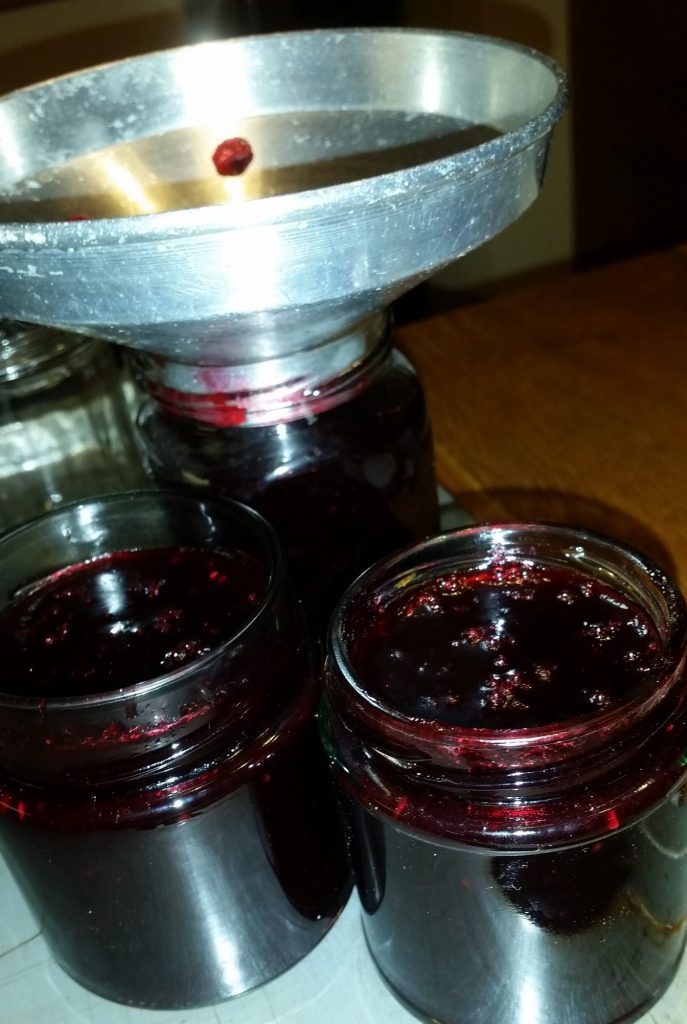
Malcolm managed to buy some extremely cheap raspberries the other day. I came home from work and there were mad amounts of fruit in the kitchen. He had also bought some strawberries, and he made some industrial quantities of strawberry jam. I made raspberry jam and it is as red as rubies, and speckled with pips, absolutely glorious on scones.
INGREDIENTS:
1 kg raspberries
1 kg sugar
Juice of 1 orange (optional)
METHOD:
Warm the sugar in the oven
Meanwhile, put the raspberries in a large jam pan with the orange juice, and bring to a simmer
Add the sugar, and bring to a hot boil, and keep boiling until you reach setting point. I use the thermometer as a general guide, and the flake test to be sure. Don’t be afraid, a fast boil on full heat works best.
Pour into clean warmed jars and seal.
The flake test: Dip a clean wooden spoon into the jam. Hold the spoon over the pan and twist it to cool the jam, then allow the cooling jam to drip from the edge of the spoon. If the drips run together and start to set, forming wide-based ‘flakes’, then the jam is at setting point.
There are many ways to make marmalade, and lots of advice about the perfect version. This is ‘method 1’ in Bulletin 21 from the Ministry of Agriculture, Fisheries and Food, printed in 1971. I got the book at a jumble sale in 1981.
I published this tonight, as I promised the recipe to someone who’d tried the marmalade. I can’t remember if she had the Aperol batch though.
INGREDIENTS:
1.5 kg seville oranges
2 lemons
2.25 litres of water
3 kg sugar
Optional extra – 200ml of Aperol – reduce water to 2 litres
METHOD:
With a potato peeler, shave strips of peel from the oranges and lemons. Cut the peel very finely, into strips about 1cm long and the thickness of a penny. You don’t need to do all the peel, it depends on how much you really like it.
Put the peel in a pan with some of the water, and simmer for around 2 hours, until the peel is tender.
Cut up the rest of the fruit coarsely and simmer with the remaining water in a closed pan for around 1 1/2 hours. When cooked, strain through a colander to remove the pips.
Add the strained juice (and optional aperol) to the peel, bring to the boil and then add the sugar, stirring until it is dissolved.
Bring the marmalade to a fast boil, until setting point is reached. When you have decided the marmalade is ready, turn off the heat, and skim off any foamy scum.
Let the marmalade cool quite a bit in the pan: this means that the peel distributes evenly in the jar.
I was looking through my old recipe book, which I have had since around 1990, for keeping notes. This is my recipe for lemon curd. It is a very basic recipe. You can add the juice of other citrous fruit but actually, lemon is still the best.
INGREDIENTS:
Juice of 2 lemons
50g butter
2 eggs
250g caster sugar
METHOD:
Beat the eggs
Put all the ingredients in a double pan (one pan sits on top of the other, boiling water in the bottom pan)
Heat very gently, stirring all the time, until the mixture is fully blended and becoming thick.
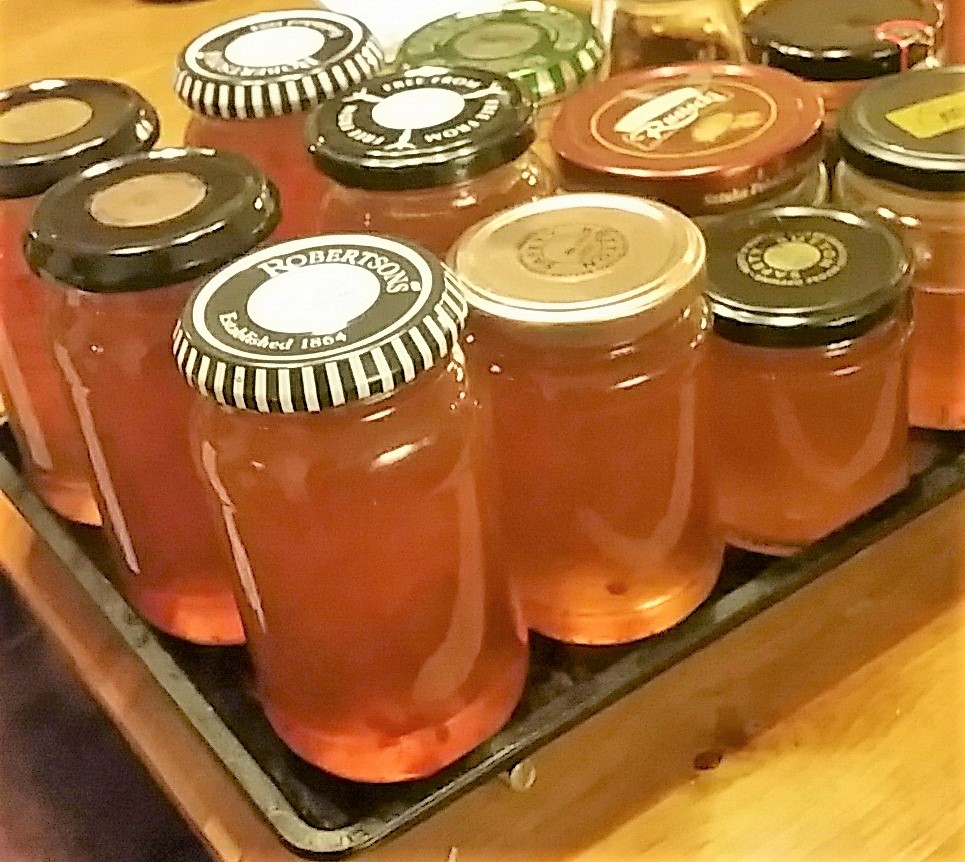
I have several recipe books devoted to preserving, jams and other such domestic creativity. This particular recipe for marmalade works well for me and for Mr B, who has very particular standards.
The marmalade should set well, be a pleasing colour, with good distribution of peel. The shreds of peel should be fine and short, about the thickness of a penny and maximum one centimetre long.
INGREDIENTS:
1 kg seville/marmalade oranges
2 kg jam sugar
2.5 litres of water
METHOD:
Wash the oranges, and put them in a large covered pan and simmer for around an hour and a half.
Remove the oranges from the liquid, and allow to cool.
Put around 8 clean jam-jars on a sheet in the oven at around 90C to warm and sterilise.
The messy bit; cut the oranges in half, and remove the pips. Scoop out the pulp and add to the pan.
To get a good set, put the pips in a small pan with some of the liquor and bring to the boil, and then strain this back into the big pan.
Next, cut the rind of three or four of the oranges into fine shreds. I do this by cutting the rind into 1cm wide strips, and then running a table knife along the inside of the peel to remove as much of the pith as possible. Then I chop into fine shreds, only adding the best ones to the pan. How much you add is a personal choice.
Start to bring the mixture to the boil, and add the sugar, stirring all the while.
Keep boiling until setting point is reached – around 222 (jam) on the thermometer. Use the wrinkle test and the flake test as well. Pour the marmalade into the warm jars, and leave to set.
A word about the flake test – this is my favourite method of checking that the jam or marmalade will set. I dip a spoon into the boiling jam and hold it horizontally. As the jam drips off the edge of the spoon, it will start to set, and the drips will start to join together, to form gelatinous webs.